AIRPORT LIQUID RULES · LHR, LGW, AMS & HEL
One suitcase.
Different liquid rules.
The shampoo that leaves London with you may not make it through the return airport. Pack for the whole journey.
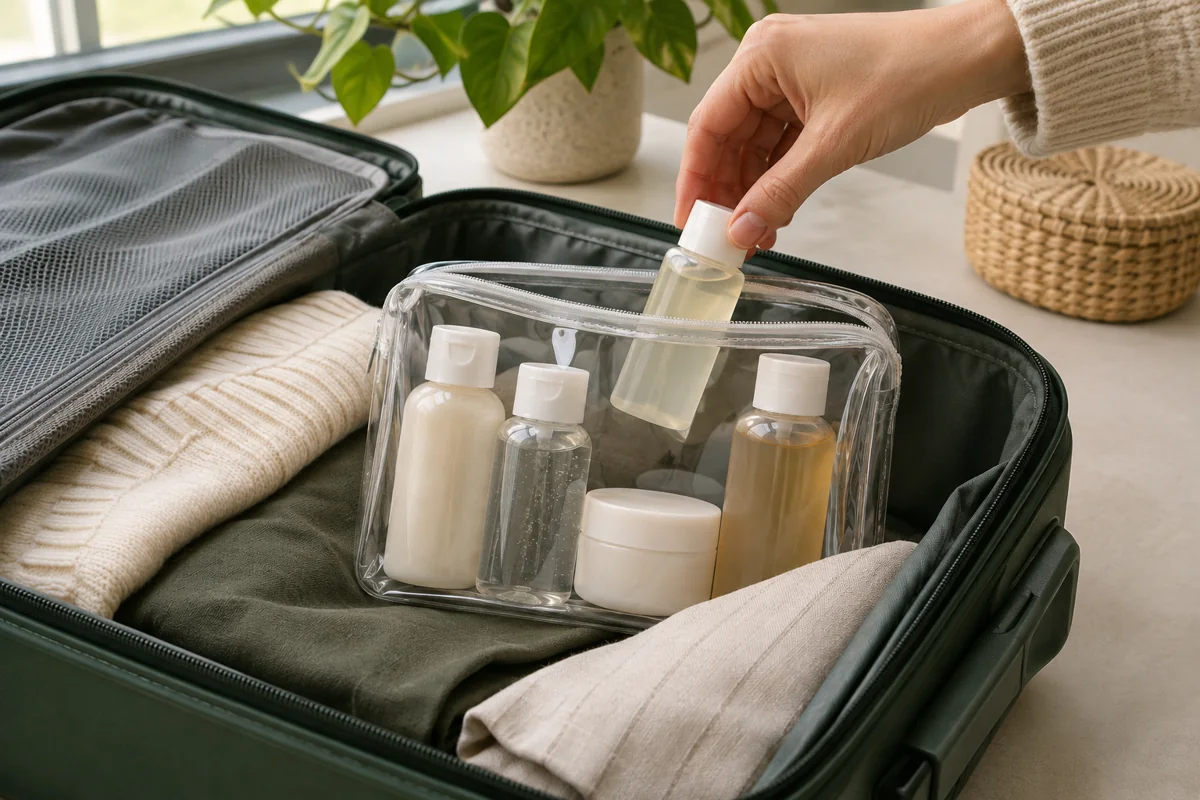
How much liquid can you take on a plane?
For ordinary toiletries, there is no single answer that covers every airport. Heathrow and Gatwick currently allow containers holding up to 2 litres through their security checks, subject to their screening conditions. Schiphol requires containers of 100ml or less in a transparent, resealable 1-litre bag. Helsinki’s departures security allows a total of 2 litres, but each ordinary liquid container must still hold no more than 100ml.
Imagine packing a 250ml shampoo bottle for a London–Amsterdam weekend. Passing the departure check in London does not make that bottle acceptable at Schiphol on the way home. The useful question is not simply whether the 100ml rule has ended. It is which checks your bag will go through before you return.
100ml or 2 litres? First, ask what the number describes.
A container limit and a total allowance are different things. The first describes the capacity of a bottle or tube. The second describes how much you can bring altogether, sometimes through the size of the required liquids bag. A half-empty oversized bottle does not become a smaller container.
The bottle
At a 100ml checkpoint, a 250ml shampoo bottle containing only a little shampoo is still a 250ml container. Decant an ordinary toiletry into a suitable smaller bottle before travelling.
The collection
A 2-litre total allowance does not mean one 2-litre bottle is permitted. Helsinki departures illustrates the distinction: ordinary containers remain limited to 100ml, even within its larger total allowance.
The UK government’s liquids guidance ↗ explains the container rule and why travellers should check departure, connecting and return airports. New scanners alone are not a reliable packing instruction.
Four airports. Three different packing instructions.
| Airport and checkpoint | Container size | What to prepare |
|---|---|---|
| Heathrow · LHRTerminals 2, 3, 4 and 5 | Up to 2 litres per container | Liquids can stay in your cabin bag. Empty reusable metal or insulated bottles. |
| Gatwick · LGW | Up to 2 litres per container | Liquids can stay in your bag. Metal or double-walled liquid containers must be empty. |
| Amsterdam Schiphol · AMS | 100ml or less per container | Use a transparent, resealable 1-litre bag. Liquids can remain in your hand baggage for screening. |
| Helsinki · HELDepartures hall security | 100ml or less per ordinary liquid container | Up to 2 litres total per passenger; liquids can stay in your bag. |
| Helsinki · HELTransfer security, if required | 100ml or less per ordinary liquid container | One transparent, resealable 1-litre bag per passenger. Be ready to present it. |
These are the named checkpoints’ instructions, not a rule for every airport in their country. Follow the staff’s directions on the day. Read the current guidance from Heathrow ↗, Gatwick ↗, Schiphol ↗ and Finavia ↗ before packing.
Being allowed to leave liquids inside your bag does not automatically mean larger bottles are allowed. Schiphol is a useful example: the airport uses CT scanners, yet its published instructions still specify 100ml containers.
The return flight is part of your packing decision.
On that London–Amsterdam weekend, the full-size toiletry may leave London successfully and still need another plan before the return. Use it up during the stay, leave it behind appropriately, or pack it in checked baggage if that item is permitted there and your ticket includes the allowance you need. Ordinary cabin-bag approval on the outward leg is not a return-trip permission.
If you want to keep the same toiletries in your cabin bag throughout this four-airport example, choose containers of 100ml or less and make them fit comfortably in a transparent, resealable 1-litre bag. This is a practical way to accommodate the stricter ordinary-liquid checks in the comparison, not a guarantee for every destination or every product.
For the exact airport arrangements, use our Heathrow, Gatwick, Schiphol and Helsinki security guides. Your airline’s cabin-bag weight and size allowance is a separate check.
A connection can bring another security check.
Not every transfer involves another screening, but if your itinerary does, the next checkpoint’s conditions matter. A bottle that passed the first airport can be too large for the next one. Check the actual transfer route rather than assuming that staying inside an airport means avoiding security.
Duty-free purchases have separate conditions. UK guidance permits qualifying airport or onboard purchases through security when they remain sealed in the security bag with the receipt visible inside. Keep that bag sealed until your final destination; screening staff may need to open it for inspection. For an international connection, confirm the next airport’s acceptance before buying a large bottle.
Heathrow also publishes a specific restriction for flights to Australia, where liquids in containers over 100ml cannot be taken. This shows why a departure airport’s general 2-litre allowance is not the complete answer for every itinerary. Read its destination guidance alongside your airline’s instructions.
The liquids bag is not just for drinks.
Toothpaste, shower gel, sunscreen lotion, perfume, mascara and liquid deodorant belong in the liquid calculation. So do foods with a liquid or spreadable consistency, such as soup, honey or jam. A small tube or jar can matter just as much as a bottle of water.
Solid toiletries can simplify a short trip: a bar of soap is different from shower gel. Do not assume every product with a similar name has the same consistency, and keep the original capacity marking readable where possible. A product being small enough does not override any separate restriction on dangerous contents.
For drinking water, an empty reusable bottle gives you an option to refill after security. Empty it before the checkpoint; Heathrow and Gatwick specifically require reusable metal or insulated/double-walled liquid containers to be empty even under their larger-container arrangements.
Keep medicines and baby food out of the ordinary-toiletries calculation.
Essential medicines, special dietary liquids, baby milk and baby food can have exemptions from ordinary liquid limits. Do not reduce or decant medication simply to copy a shampoo-packing example. Check the checkpoint’s specific instructions, the quantity allowed for your journey and any supporting documents before travelling.
For UK checkpoints, the official exemptions guidance ↗ sets out the relevant categories. For Helsinki, Finavia separately allows the baby food and medicines needed during the trip. Screening requirements still apply. Bring these items somewhere accessible so you can present them when asked.
One small check before you zip the suitcase.
YOUR PACKING MEMO
- List your departure airport, any transfer security check and the airport for the flight home.
- Compare the container limit, total or bag allowance and what must come out of your bag at each check.
- Check medicines and duty-free purchases separately.
Then choose what suits the trip: small refillable toiletries, products bought at the destination, or permitted liquids in checked baggage. Pack once around the complete journey, and the shampoo bottle becomes one less decision at security.